Hybrid vs battery robotic mowers: why duty cycle decides daily output
Deck width is the number everyone compares. It is not the number that determines how much ground a robotic mower actually covers in a working day.
We build a hybrid machine, so treat this page as an argument with an interest behind it. It is still arithmetic, and the arithmetic is checkable. Where battery-only is the better buy, we say so at the bottom.
The number nobody compares
Spec sheets for autonomous mowers lead with cutting width, then top speed, then battery capacity. All three feed into a theoretical rate: deck width times speed gives you acres per hour on paper.
What decides real output is duty cycle — the fraction of the working day the machine spends with blades in grass, rather than driving to a dock, sitting on a charger, or waiting for a window when someone can swap a pack.
A machine with a 30-inch deck at 80% duty cycle covers more ground in a day than a 40-inch machine at 45%. Deck width is linear. Duty cycle is the multiplier applied to it, and it is the one that varies by a factor of two between machine types.
How a battery-only robot spends its day
The pattern is the same across the category, from residential units up to large commercial models:
- Mow until the pack reaches its reserve threshold.
- Drive back to the charging station — which on a large property may be several minutes each way, across ground that has already been cut.
- Charge. This is the long part, and it does not scale down: bigger pack, longer charge.
- Drive back out to the resume point and continue.
Two of those four steps produce no cut grass. On a small maintained lawn the round trip barely matters, because the machine has all night and the property is a fraction of an acre. On multi-acre commercial ground, where you want the mowing finished inside a specific window, it matters a great deal — and the charging interval lands in the middle of the working day rather than politely at the end of it.
The usual workaround is to buy more machines, so that one is always cutting while another charges. That works. It also means the capital comparison is no longer one battery machine against one hybrid.
How a hybrid spends its day
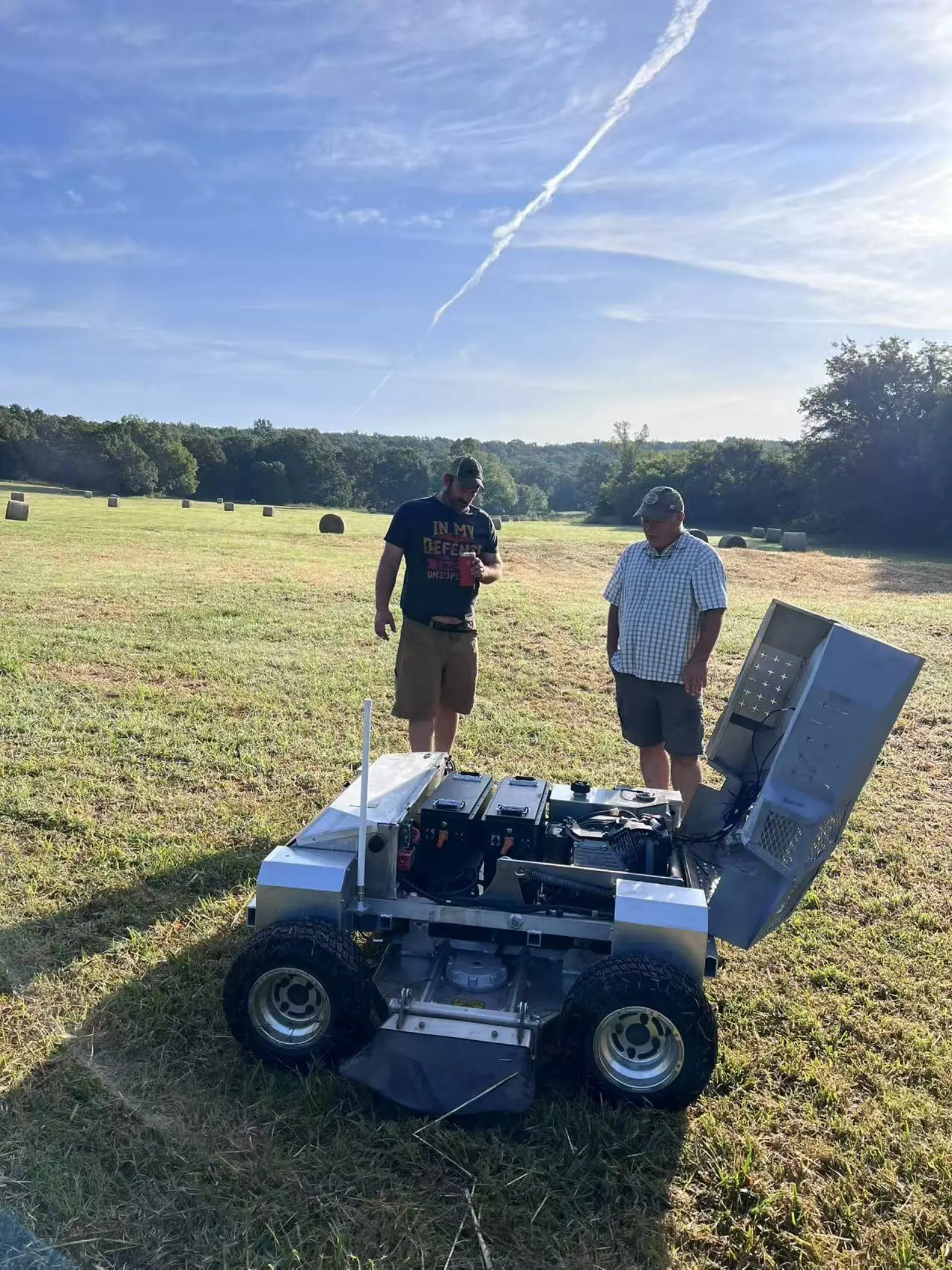
The A60i carries a battery pack and a small engine driving a generator. The engine does not turn the wheels; the electric drive does. The engine's only job is to put charge back into the pack while the machine is cutting.
So the machine does not have a charging cycle to schedule. It has a fuel tank, and one tank is twelve hours of mowing. Refuelling is a two-minute job that happens when you decide, using a procedure every grounds crew already knows, and it can be done at the far end of the property rather than at a fixed dock.
Twelve hours is not a marketing figure chosen to sound large; it is a full working shift, which is the unit that actually matters when you are scheduling ground. It means the machine's runtime stops being a constraint on the plan at all. Duty cycle becomes an operational choice rather than a property of the battery.
"But a generator burns fuel — isn't that worse?"
It is the obvious objection and it deserves a real answer. Two things make the fuel figure better than intuition suggests.
The engine runs at one operating point. A conventional mower's engine has to follow the load: it labours through thick grass, revs through turns, idles across transport runs. Efficiency swings with it. A range extender holds a steady, efficient output, and the battery absorbs the variation. That is the same reason series-hybrid drivetrains are used in rail and marine applications. The A60i's range extender is electronically fuel injected, which is what lets it hold that point precisely — metering fuel to the actual air charge instead of to whatever a carburettor jet was set for at a different temperature and altitude.
The electric drive handles the peaks. Traction demand on a mower is spiky — climbing, turning, cutting into a heavy patch. Motors supply those peaks from the pack rather than forcing the engine to size for them.
The net result on the A60i is 3 to 4 litres an hour, cutting 7,000 m² in that hour. That works out at roughly 1.7 to 2.3 litres per acre — call it a dollar fifty to two dollars of fuel per acre at typical US pump prices. Set that beside the $40 an acre that contracted commercial mowing is commonly quoted at and the fuel line stops being the argument at all. Not zero. Nowhere near the thing that decides the economics either.
The weight side effect, which nobody expects
Intuition says adding an engine to a battery machine must make it heavier. In practice the opposite happens, because of what the engine lets you leave out.
A battery-only machine sized for a working day has to carry every kilowatt-hour of that day in cells. Packs are the heaviest single component on those machines, and the runtime requirement sets their size. A range-extended machine carries a much smaller pack — enough to buffer the peaks — plus a small engine and a tank of fuel, which is a far lighter way to store the same day's energy.
Combine that with an automotive-grade all-aluminium body and the A60i comes in at 280 kg (617 lb). The closest directly comparable machine we can find — another autonomous 60-inch deck, from a different manufacturer — is published at 1,250 lb. Same cutting width, twice the mass. On turf that is not a specification footnote:
- Less compaction and rutting on ground being cut every week
- Better traction per driven wheel, because there is less mass to hold on a grade
- Less energy spent moving the machine rather than cutting grass — part of the fuel figure above
- Light-duty trailering between sites instead of heavy-equipment transport
The other thing that changes: pack life
A battery-only machine deep-cycles its pack every working day — charge to near-full, discharge to reserve, repeat. Cycle count is what wears a pack out, and pack replacement is a real line item that tends to arrive somewhere around year four or five, at a cost that rarely appears in the original ROI model.
In a range-extended machine the pack is being trickled rather than drained: shallow cycles, kept away from both extremes of state of charge. That is a gentler duty for the cells.
Side by side
| Battery-only autonomous mower | Hybrid (range-extended) — A60i | |
|---|---|---|
| Runtime limit | Pack capacity | Fuel tank — 12 hours per fill |
| Interruption | Return to dock and charge, mid-day | Refuel in two minutes, when you choose |
| Machine weight | Heavy — runtime is stored in cells | 30–50% lighter — small pack, aluminium body |
| Dead travel | To and from the dock, over cut ground | None — service it where it stands |
| Infrastructure | Charging station, power run to it | Fuel can |
| Scaling output | Add machines | Add hours |
| Pack duty | Deep cycle, daily | Shallow cycle, continuously topped |
| Local emissions | Zero at the machine | Low, but not zero |
| Noise | Lowest | Low — far below a gas commercial mower |
Where battery-only is the better buy
Plainly, because it is often true:
- Small maintained properties. Under an acre or two, charging time is irrelevant and a battery robot is cheaper, simpler and quieter.
- Zero-emission mandates at the point of use. Some campuses, municipalities and indoor-adjacent sites have policies that a combustion engine cannot satisfy, whatever its efficiency. That is a real constraint and no amount of arithmetic overrides it.
- Overnight windows with no deadline. If the machine has twelve unattended hours to cover three acres, duty cycle stops mattering. Buy the cheaper machine.
- Noise-critical sites. Battery is the quietest thing available. If you are cutting beside occupied buildings at 5am, that may outweigh everything else.
The short version. If your constraint is daily output on multi-acre ground — a golf course, a sod farm, an airfield, a solar site, a contractor's route — duty cycle is the number that decides what you get, and twelve hours on one tank wins it. If your constraint is emissions policy, noise, or a property small enough that time is not scarce, battery wins. Everything else is deck width, which both types can have.
Cross-shopping specific machines? The 2026 buyer’s guide puts six commercial robots in one table, and A60i vs Husqvarna CEORA takes the battery comparison head to head.
A60i specifications · Price and ROI · Run the payback numbers