Robot mowers on slopes and rough terrain
Banks, ditch lines, basin walls and overgrown margins are where most robotic mowers quietly stop being autonomous — because somebody has to go back with a trimmer and finish what the machine could not climb.
Why two-wheel drive fails on a bank, specifically
It is not a power problem. It is a weight-transfer problem.
On a slope, load shifts off the uphill wheels and onto the downhill ones. A machine driving only one axle now has some of its driven wheels lightly loaded, and a lightly loaded driven wheel does not put torque into the ground — it spins. Once it spins on turf it does two things at once: it stops climbing, and it tears the surface it is standing on.
Add moisture and it gets worse quickly. Wet grass on a grade is the standard condition in which operators discover that a machine rated for a slope on a dry test lawn does not hold it on their site.
The practical consequence is not that the machine falls over. It is that the bank ends up with uncut patches and torn strips, and a person walks out with a string trimmer to fix it — which is the exact labour the machine was bought to eliminate.
What four-wheel drive changes
Every wheel on the A60i is driven by its own electric motor. When weight transfers off one corner, the loaded corners keep pulling. Traction degrades gradually with grade and moisture rather than disappearing at a threshold.
Two supporting design choices matter as much as the drivetrain:
- Turf tires with low ground pressure. Traction is a function of the contact patch, not just of how many wheels turn. Low pressure also means the machine is not the thing damaging the slope it just climbed.
- Automotive-grade all-aluminium body. At 30 to 50 percent lighter than comparable machines there is less mass to hold on a grade, less mass to stop on the way down, and less mass pressing into soft ground. On a slope weight is the enemy twice: it is what wants to slide, and it is what tears turf when a wheel breaks traction.
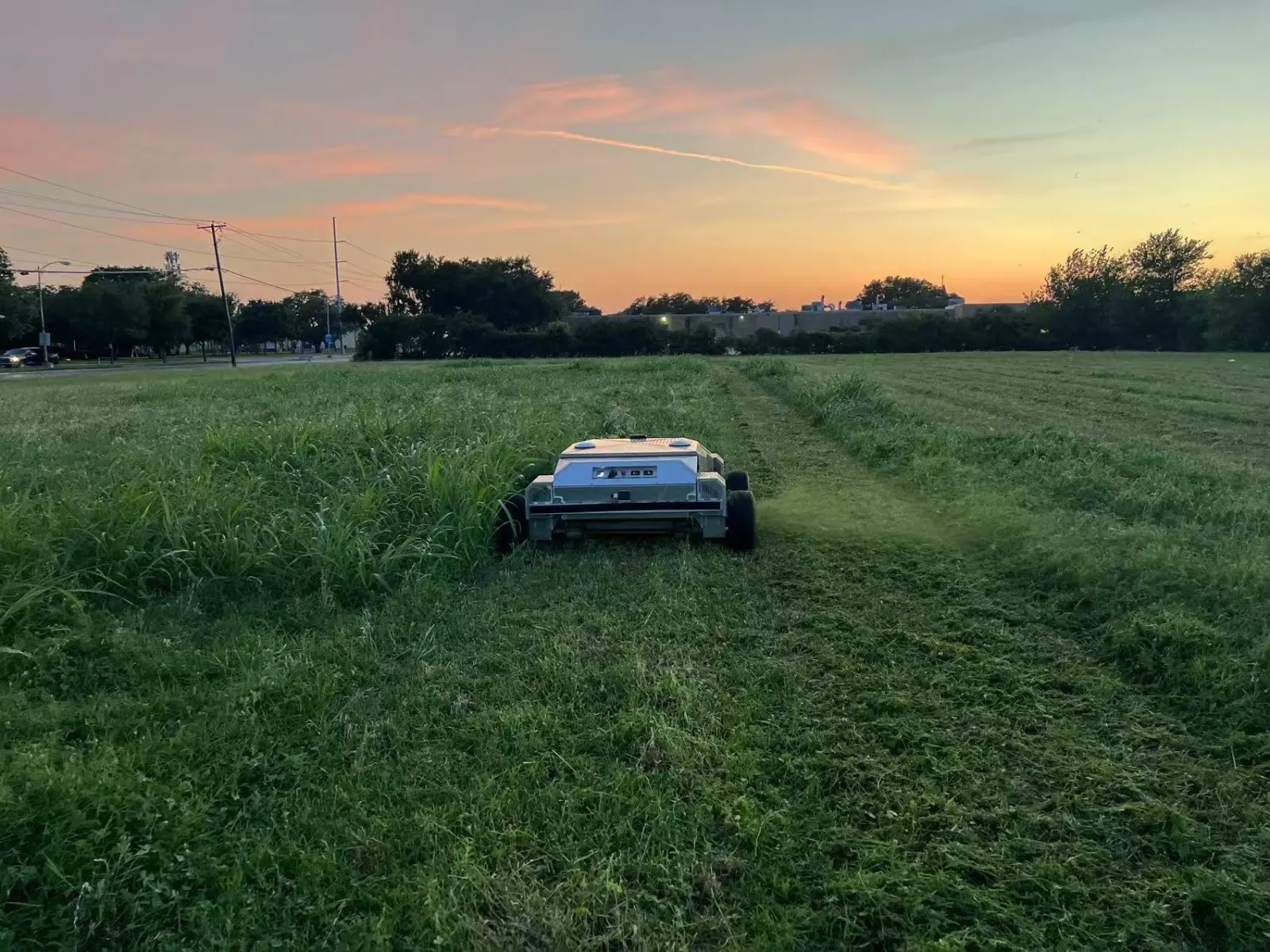
Our number: 30 degrees, and what that does and does not mean
The A60i is rated to 30 degrees. Note the unit, because it carries the whole meaning: 30 degrees is a 57.7% grade. It is not "30%", which would be 16.7 degrees — barely half the angle and a completely different piece of ground.
For scale, Husqvarna publishes 20% for the CEORA inside its installation, and 15% at the boundary. 20% is 11.3 degrees. So the A60i is rated for close to three times the angle of the nearest RTK robot most people cross-shop it against.
Why an electric drivetrain changes the ceiling
On conventional mowers the slope limit is often not about traction at all — it is about lubrication and fuel pickup. Tilt an engine far enough and the oil pump starts drawing air instead of oil, which is why so many petrol machines carry a slope rating well below what their tyres could actually hold.
The A60i drives all four wheels electrically. No engine turns a wheel and there is no hydrostatic transmission in the drive path, so the ceiling is set by traction and stability — by grip and by where the centre of mass sits — rather than by an oil sump. Add a 280 kg all-aluminium machine, which is roughly half the mass of a comparable 60-inch autonomous mower, and there is simply less weight wanting to slide downhill in the first place.
What the rating still does not tell you
A number on a datasheet is measured under conditions, and yours will differ. Maximum workable grade on your ground depends on:
- Turf species and how dense the sward is
- Moisture — the same bank is a different machine test after rain
- Cutting height, and how much material the deck is handling
- Whether the machine is traversing, climbing or descending
- Surface condition: thatch, ruts, exposed soil, loose stone
So treat 30 degrees as the ceiling under good conditions, not as a promise about a wet bank in spring. Send us photographs and grades and you will get a specific answer for your site, including when the answer is that a piece of ground needs a different machine.
If you are comparing spec sheets right now: check whether every slope figure you are looking at is in the same unit, and convert them all to one before you compare. Ours is 30 degrees = 57.7%. A machine advertised at "45" means something very different at 45 percent grade (about 24 degrees) than at 45 degrees (100 percent grade — steeper than almost any mown ground exists). Ask each supplier to confirm the unit in writing; a surprising number cannot, immediately.
Rough terrain, which is a separate problem from slope
Slope and roughness fail machines differently. Rough ground — ruts, tussocks, dips, debris, heavy lodged growth — is about ground clearance, deck robustness and having enough torque to keep moving when the deck loads up unevenly.
This is where a wide rotary deck driven by an electric drivetrain is at an advantage over a belt-driven machine: motors deliver torque instantly when the load spikes, instead of a belt slipping or an engine bogging. The place it is still at a disadvantage is rock. Rotary decks and buried stone do not mix, on any machine. Ground that has never been graded may need a first pass by other means before an autonomous machine takes over the cycle.
Where this shows up on real properties
- Golf: bunker surrounds, mounding and bank faces — golf courses
- Municipal: detention basins, drainage margins, highway right-of-way — parks and municipal
- Solar: graded pads, access-lane shoulders, perimeter banks — solar sites
- Contractors: the awkward corner of every large account that nobody wants to bid — contractors
Terrain questions
What slope can the A60i actually work?
It depends on turf, moisture and cut height, so we quote it against your site rather than printing one number. Send grades and photographs and we will give you a specific, written answer.
Will it tear the turf on a bank?
Driving all four wheels is what prevents the spin that tears turf in the first place. Combined with turf tires and a light chassis, ground pressure stays low. On saturated ground, no machine should be on the slope — that judgement does not change with autonomy.
Can it handle grass that has got away from us?
Heavy, lodged growth is a torque and deck-loading problem, and it is one the electric drivetrain handles well. Extremely overgrown ground may still want a first cut at a higher setting before dropping to the maintained height.
What about rocks and debris?
Rotary decks and rock are a bad combination on any machine. Ground with buried stone needs to be cleared or handled differently — tell us up front rather than after a blade strike.
Does it work on wet ground?
Better than a two-wheel-drive machine, because torque stays on the loaded corners. But wet ground is still wet ground: the right call on saturated turf is to wait, and an autonomous machine makes that easier because the missed window can be picked up the same night.