Autonomous mowers for parks and municipal grounds
Most municipal grounds departments are not short of budget for mowing. They are short of people to do it, and have been for several seasons running. That is a different problem, and it has a different fix.
The backlog is structural, not seasonal
The pattern repeats across parks departments: an approved headcount that cannot be filled, seasonal staff who arrive late and leave early, and an acreage figure that does not shrink to match. The result is a mowing rotation that stretches from ten days to fourteen to twenty, and complaints that arrive on exactly the same curve.
Overtime patches it for a while. Contracting out patches it at a price. Neither addresses the fact that the repetitive acreage — the open park ground, the medians, the campus lawns, the detention basins — consumes the majority of the available hours while requiring the least judgement of any job in the department.
That acreage is what an autonomous machine is for.
What fits, on public ground
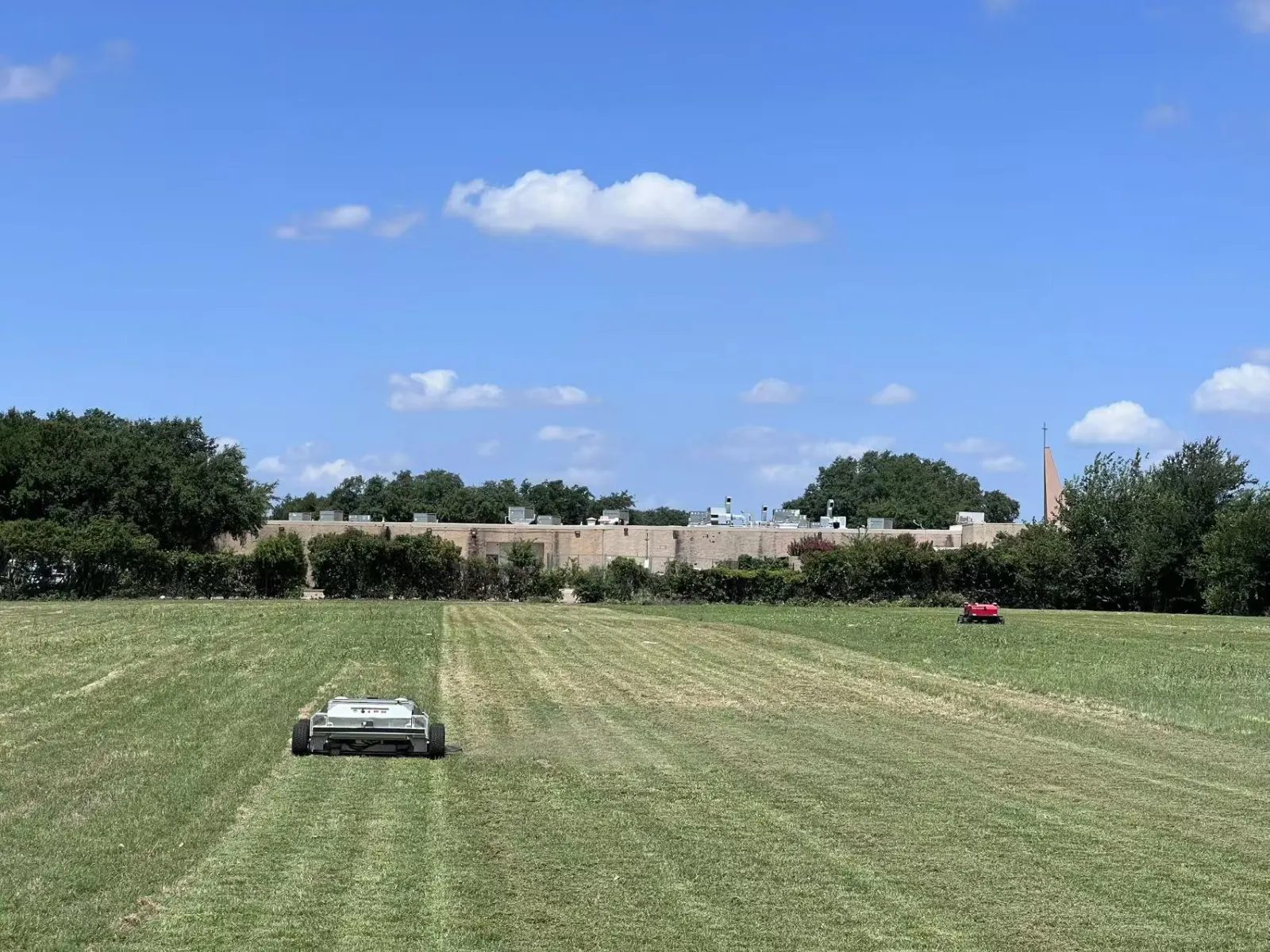
- Open park acreage. Long runs, few obstacles, cut on a fixed rotation.
- Sports and recreation fields within the park system — see sports fields.
- Detention basins, drainage margins and right-of-way — ground that is awkward, unloved, and often on a slope. More on terrain →
- Civic campuses and municipal facility grounds.
- Not: narrow streetscape planting, tight median strips with heavy furniture, or anywhere the work is mostly trimming rather than mowing.
Three things that matter specifically in a public setting
Noise, and when the work can happen
Conventional commercial mowers sit above 90 dB, which is why park mowing tends to happen in daylight and generates its own complaint stream. A machine quiet enough to work at first light does the ground before the park fills up — and with twelve hours of runtime on one tank, the early window is long enough to finish real acreage rather than one lawn.
Public interaction
Unattended equipment on open public ground is a legitimate question, not a detail. Obstacle detection and emergency stop are on board and work areas are defined in software, but the operational answer on most sites is scheduling: run it in low-traffic windows, fence or flag active areas where local policy requires it, and treat it like any other powered equipment in a public space.
Procurement and documentation
The price is published — $39,800 USD ex-works, on the price page — which makes a budget request straightforward to write. For formal procurement we supply specifications, compliance documentation and references on request. Ask early; document requests are the usual reason a purchase slips a cycle.
Building the case internally
The argument that survives a council meeting is usually not "it saves money on mowing". It is:
- The rotation returns to the interval the department publishes, and stays there.
- Crew hours move to work residents actually see — beds, litter, playground inspection, trees.
- The department stops competing for seasonal labour it has repeatedly failed to hire.
- One machine can serve several sites, so the capital line does not scale with the acreage — and at 30 to 50 percent lighter than comparable machines it moves on a light-duty trailer rather than needing heavy-equipment transport between them.
Run your own numbers first — the calculator is deliberately honest about when mowing cost alone does not carry the case.
Questions from parks departments
Can it operate in a park that is open to the public?
With obstacle detection, defined work areas and sensible scheduling, yes — but most departments get the value from running it outside peak hours, which is what unattended operation makes possible in the first place.
How do we move it between sites?
Trailer it like any other grounds machine. Each site's work areas are defined once and stored.
What happens in bad weather?
Same judgement as any mowing operation: soft ground and heavy rain are reasons not to cut, whatever machine you use. The advantage of autonomy is that a missed window can be picked up the same night rather than waiting for crew availability.
Do you supply documentation for formal procurement?
Yes — specifications, compliance documentation and references. Tell us what your process requires and we will send it.
Is there a demonstration programme?
Yes. We arrange on-site demonstrations, which for public bodies is usually the fastest route to a decision that survives review.