What the A60i actually does differently
Four things separate this machine from a scaled-up residential robot mower: how it drives, how it navigates, how it is powered, and how you control it. Here is each one, in order of how much it changes on a real property.
Hybrid power: the machine refuels, it does not dock
Under the hood there is a battery pack and a small engine driving a generator. The engine does not turn the wheels. It runs at an efficient operating point and puts charge back into the pack while the machine is cutting.
The consequence is the whole reason the machine exists: one tank of gasoline is twelve hours of mowing. A battery-only robot mower has to stop, drive back to a dock, and charge — and on a large property that dead time falls in the middle of the working day. The A60i's runtime constraint is a fuel tank, and topping a fuel tank is a two-minute job any grounds crew already knows how to do, at a time of your choosing.
Twelve hours is a full shift. It is also more than most properties need in a day, which means the useful question stops being "will it finish before it has to charge" and becomes "what time do you want it to start".
Running the engine as a generator instead of as a direct drive is also why fuel consumption comes in up to 30% below a conventional commercial mower doing the same work: the engine never has to follow the load, it just holds a steady output while the electric drive handles the varying demand of turning, climbing and cutting through heavy grass.
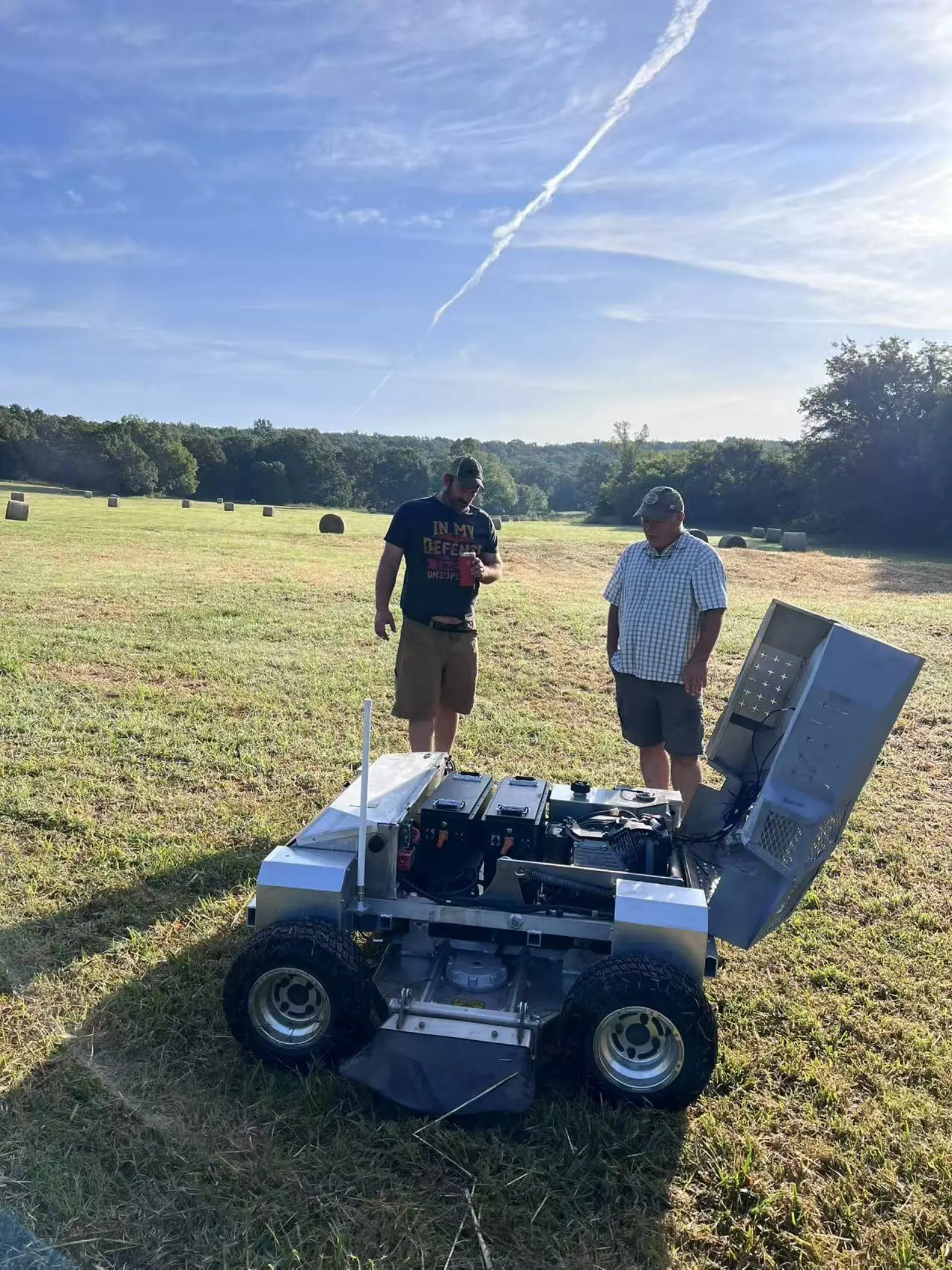
Automotive-grade aluminium body, four-wheel drive
The body is all-aluminium, built the way a vehicle body is built rather than as a steel frame with panels hung on it. The finished machine weighs 280 kg (617 lb) — against machines of comparable cutting width that is 30 to 50 percent lighter, and the closest published 60-inch autonomous rival is 1,250 lb, almost exactly double. On turf, weight is never neutral. A lighter machine compacts less, ruts less on soft ground, needs less energy to move and turn, trailers on light-duty equipment, and does not corrode from underneath after five wet seasons.
Light and four-wheel drive together are the point. Each helps the other:
Every wheel is driven by an electric motor. That matters in two situations that come up on nearly every commercial property.
The first is grade. A two-wheel-drive machine on a bank spins the unloaded wheel, stops climbing, and leaves an uncut patch that somebody has to go back for with a trimmer. Driving all four wheels keeps torque on the ground when weight transfers off one corner.
The second is soft or uneven ground — after rain, along ditch lines, on rutted margins. Independent drive on four corners keeps the machine moving instead of digging in, and turf tires spread the load so the machine is not the thing that damages the surface it just cut.
- Electric drive at all four wheels, no hydraulic drivetrain to leak
- Turf tires sized to keep ground pressure low
- Automotive-grade all-aluminium body — 280 kg (617 lb), 30–50% lighter than comparable machines
- Light enough to work the same ground weekly without printing wheel tracks into it
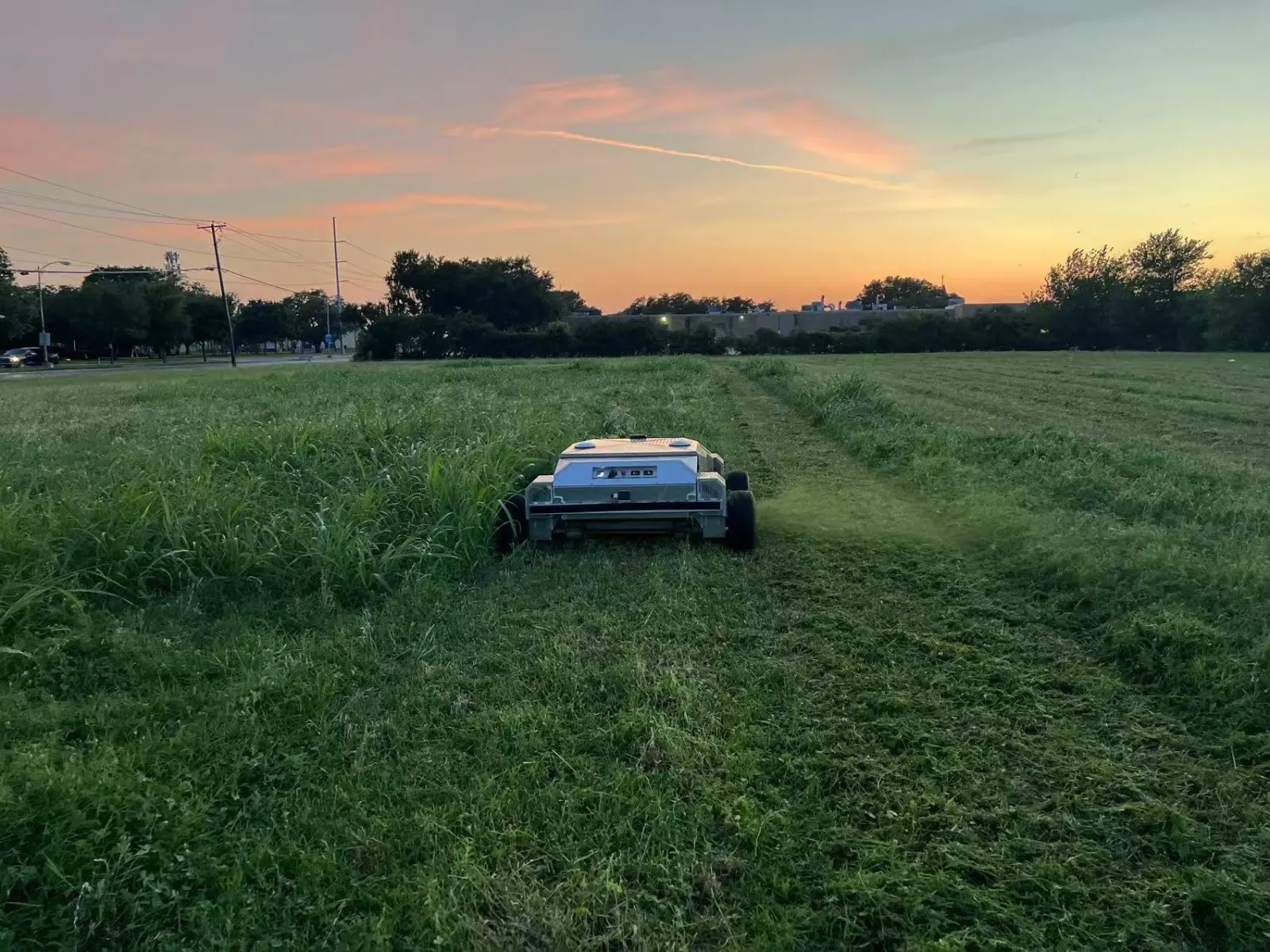
RTK GPS with dual-antenna heading — about one inch
The A60i positions itself from RTK GNSS corrections, and it carries two antennas rather than one. The second antenna is what gives the machine a true heading: it knows not just where it is, but which direction it is facing, without having to move first to work it out.
That is the difference between a machine that can follow a planned line and one that wanders. Older robot mowers bounce around inside a wire loop and rely on statistics to eventually cover the area. The A60i drives a route, at roughly one inch of position accuracy.
Three practical results:
- No double-cutting. Passes butt up against each other instead of overlapping by a foot for safety, so a given area takes fewer passes.
- Repeatable stripes. On anything anyone looks at — a range, a field, a frontage — the pattern comes out the same every time.
- No wire. Boundaries and exclusion zones are drawn in software. Nothing gets trenched in, and nothing gets severed by an aerator two seasons later.
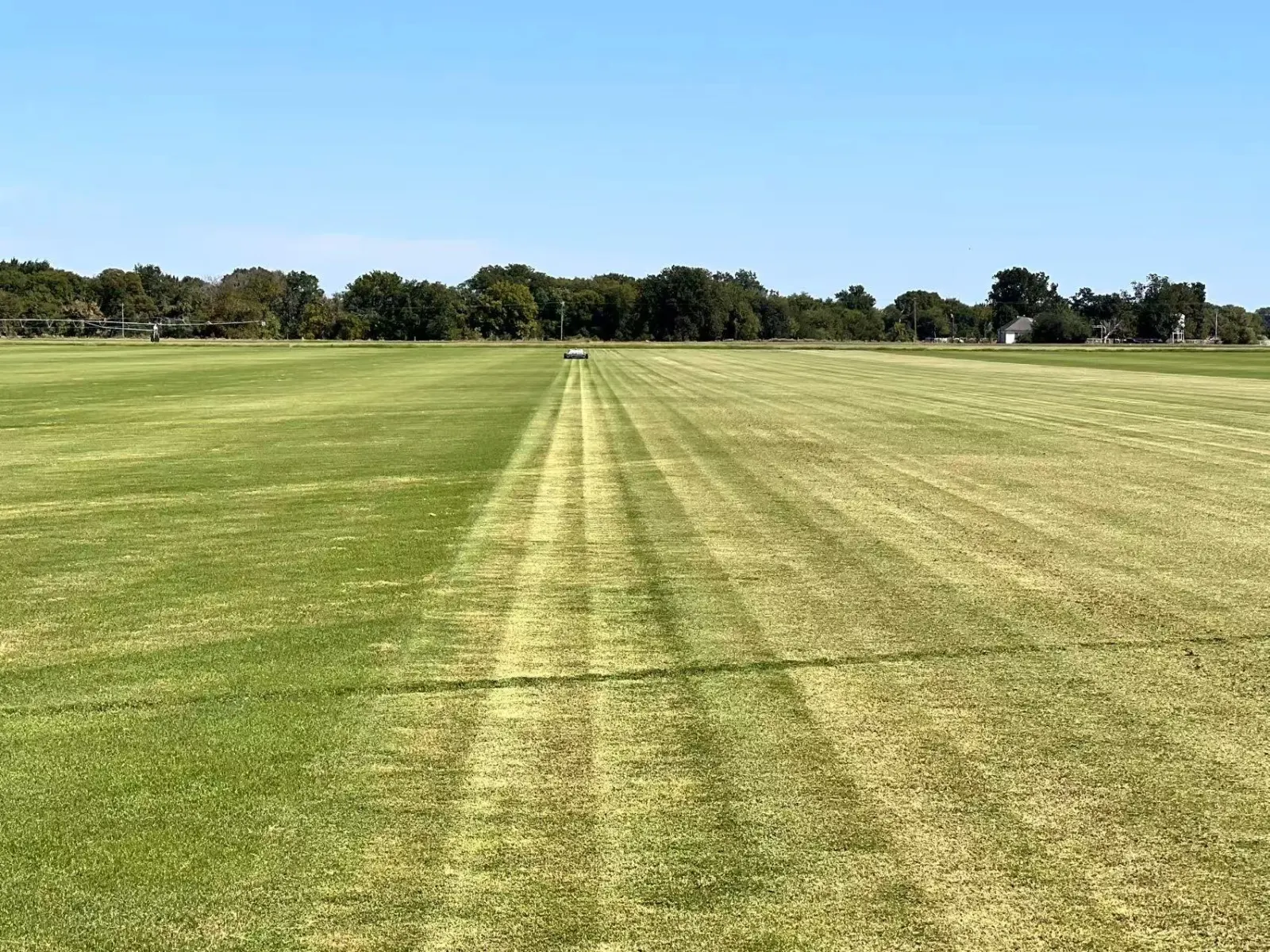
The deck, and what you do from your phone
60-inch three-disc deck
A 1,525 mm working width carried on three blade discs. Wide enough that acreage goes down in a realistic number of passes, and a discharge arrangement that handles the volume of clippings a wide deck actually produces.
Remote height adjustment
Cutting height is set remotely rather than by pulling pins at the deck. Changing height between a maintained field and a rough margin is a setting, not a job.
Obstacle detection and e-stop
Onboard sensing plus an emergency stop. Combined with software no-go zones, the machine is kept away from bunkers, beds, inverters, pedestals and anything else that should not be driven over.
7,000 m² an hour
About 1.73 acres an hour at a working speed of 1.4 m/s (3.1 mph) — sustained with the deck engaged, not a transport figure quoted with the blades off. Fuel burn at that rate is 3–4 litres an hour.
Quiet enough to run off-hours
Conventional gas mowers sit above 90 dB. A machine that can work at first light or after close without generating complaints is a machine that can work when the property is empty.
Runs unattended
The point is not that it mows. The point is that it mows while your people are doing the work that actually requires people: edging, detail, irrigation, agronomy.
See the numbers
Full specifications, published price, and a calculator that works out payback for your acreage and mowing frequency.