Autonomous mowing for sod farms and turf farms
On a sod farm the grass is not landscaping, it is inventory. Mowing frequency, cut quality and what the machine does to the ground it drives on all feed straight into what you can harvest and sell — which is why weight matters here more than anywhere else.
Why sod production is the best case for a wide autonomous deck
Everything that makes autonomous mowing inefficient elsewhere is absent on a turf farm:
- Enormous open runs. Fields are laid out for machinery, with pass lengths measured in hundreds of yards. A 60-inch deck spends its time cutting instead of turning — which is exactly where the economics of a wide autonomous machine come from.
- Almost no obstacles. No beds, no trees every thirty feet, no street furniture. Irrigation and headlands are fixed and can be defined once as no-go zones.
- Relentless frequency. Production turf is cut constantly through the season, at a height that has to be held. That is the highest acre-cut count of any application, and acre-cuts are what pay for the machine.
- Labour that is hard to keep. Driving a mower up and down a field for ten hours is the job with the highest turnover on most farms.
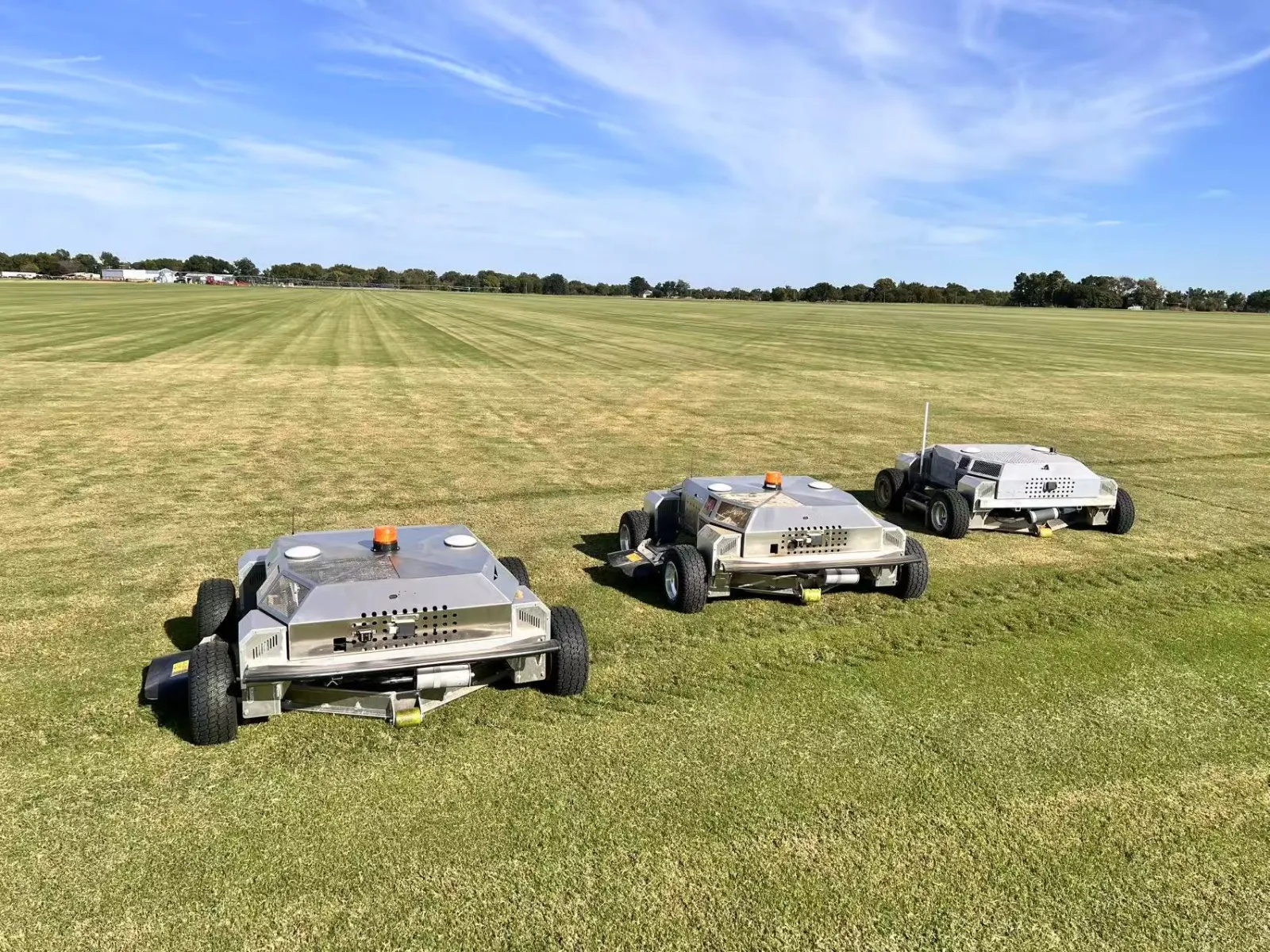
The photographs on this site are from working turf farms, not renders. That is the ground this machine has spent the most hours on.
Weight is a product-quality issue, not a comfort issue
This is the argument that matters most on a sod farm and gets the least attention in equipment specifications.
The A60i has an automotive-grade all-aluminium body, which makes it 30 to 50 percent lighter than comparable machines of similar cutting width. On a lawn that is a nice-to-have. On a field you are going to harvest, it is the difference between a crop you can lift cleanly and one with compaction stripes running through it.
- Less compaction under the wheel track. Weight over contact area is what compacts soil. Compacted lanes grow differently, colour differently and lift differently — and on production turf that shows up in the finished roll.
- Fewer ruts after rain. The cutting schedule does not pause because the field is soft, and a light machine on turf tires can work ground that a heavy mower would tear.
- Root zone left intact. Lighter passes mean less mechanical stress on a crop whose value is precisely its root mat.
- An aluminium body does not corrode. Wet grass, irrigation and fertiliser are a steel frame's whole life story. They are not aluminium's.
Twelve hours on one tank — because there is no outlet in the middle of a field
A battery-only machine on a turf farm has an infrastructure problem before it has a mowing problem: the charging station needs power, and power at the far end of a production field is a trenching project.
The A60i's range extender charges the pack while the machine cuts, so one tank of fuel is twelve hours of mowing — a full production shift. Refuelling is a fuel can and two minutes, done wherever the machine happens to be. Nothing has to be built. Why duty cycle decides output →
RTK guidance and a consistent cut
Cut consistency across a field is a saleability question. RTK GPS with dual-antenna heading holds passes to about an inch, so lanes butt edge to edge without an overlap band being cut twice and without a missed strip running through a block you are about to harvest.
It also means the pattern is repeatable between cuts rather than depending on who was driving, and cut height is set remotely rather than at the deck — so raising height ahead of a heat event, or dropping it before harvest, is a setting rather than a shop job across every machine.
Running more than one
Sod farms are one of the few applications where multiple machines make immediate sense: acreage is large, the work is uniform, and the marginal machine adds acre-cuts without adding staff. The photographs above are three machines on one property. If you are sizing a fleet, send us field acreage, cutting frequency and target cut height and we will work out the machine count rather than quoting you one and hoping.
Honest limits
- Harvest operations are unchanged. This is a mower. Cutting, lifting, stacking and transport are still your existing equipment and crew.
- Very rough or newly graded ground. Rotary decks and buried stone do not mix. Establishment fields may need a first pass by other means.
- You need an RTK correction source. Most farms already have one for other guided equipment; if not, a local base station is straightforward but has to be set up before delivery.
Questions from turf growers
How many acres can one robotic mower keep on cycle on a sod farm?
Roughly 15 to 21 acres on one tank, a full working shift per fill. Real throughput depends on cut height, growth rate and field layout — send us those and we will give you a planning figure you can build a schedule around.
Will an autonomous mower mark or compact a turf field?
That is exactly what the aluminium body is for: 30 to 50 percent lighter than comparable machines, on turf tires, so ground pressure stays low. It is the single most relevant specification on a farm that sells the ground it drives over.
Can a robotic mower hold a low production cut height?
Cutting height is remotely adjustable across its range. Tell us the height you hold and the species you grow and we will confirm against your specification before you order.
Can several robotic mowers work the same sod farm field?
Yes — work areas are defined per machine so they cut adjacent blocks without overlapping. Fleet layout is part of commissioning.
Can we see an autonomous mower on a working turf farm?
Yes. This is the application with the most machines in service, so a reference site is usually straightforward to arrange. Ask for a demo.
Why sod farms and airfields are the two best cases for autonomous mowing →