Robotic mowing for golf courses and driving ranges
Autonomous mowing on a golf property is not about replacing the crew. It is about moving the repetitive acreage off the crew's morning so the hours go somewhere they are actually visible.
Where it fits on a golf property, and where it does not
Start with the boundary, because getting this wrong wastes everybody's time. The A60i is a rotary machine with a 60-inch deck. It belongs on:
- Roughs and out-of-play areas — the largest single acreage on most courses and the one that consumes the most repetitive hours.
- Driving ranges and practice grounds — large, open, cut constantly, and the place where a wide autonomous deck is at its most efficient.
- Perimeters, margins and maintenance areas — the ground that gets cut last and shows it.
It does not belong on greens, tees or fairway approaches that need a reel cut. Nobody should sell you a rotary robot for fine turf, and we will not.
The three things superintendents actually get from it
1. The rough gets cut on schedule, every week
Rough mowing is the first job to slip when the crew is short, and the last one to catch up. It is also the acreage most visible to a player walking off line. An autonomous machine cutting the same area on a fixed cycle removes that variability entirely: the rough is on a schedule that does not depend on who called in.
2. Overnight and off-hours operation
A machine quiet enough to run before first light finishes ground before the first group goes out, and twelve hours of runtime means the overnight window is never the limiting factor. That converts mowing from something that has to be worked around play into something that happens when the course is empty. On courses with tight tee sheets this is often the single most valuable property of the machine — more than the cost per acre.
3. Crew hours move to work that shows
Every hour not spent driving laps of the rough is an hour available for bunker work, detail around greens, irrigation repairs, or agronomy. This is where the return actually lands on a golf property, and it is the part a simple cost-per-acre calculation never captures. The calculator is honest about that.
Why RTK guidance matters more on a course than anywhere else
Two reasons, and they are both about what people see.
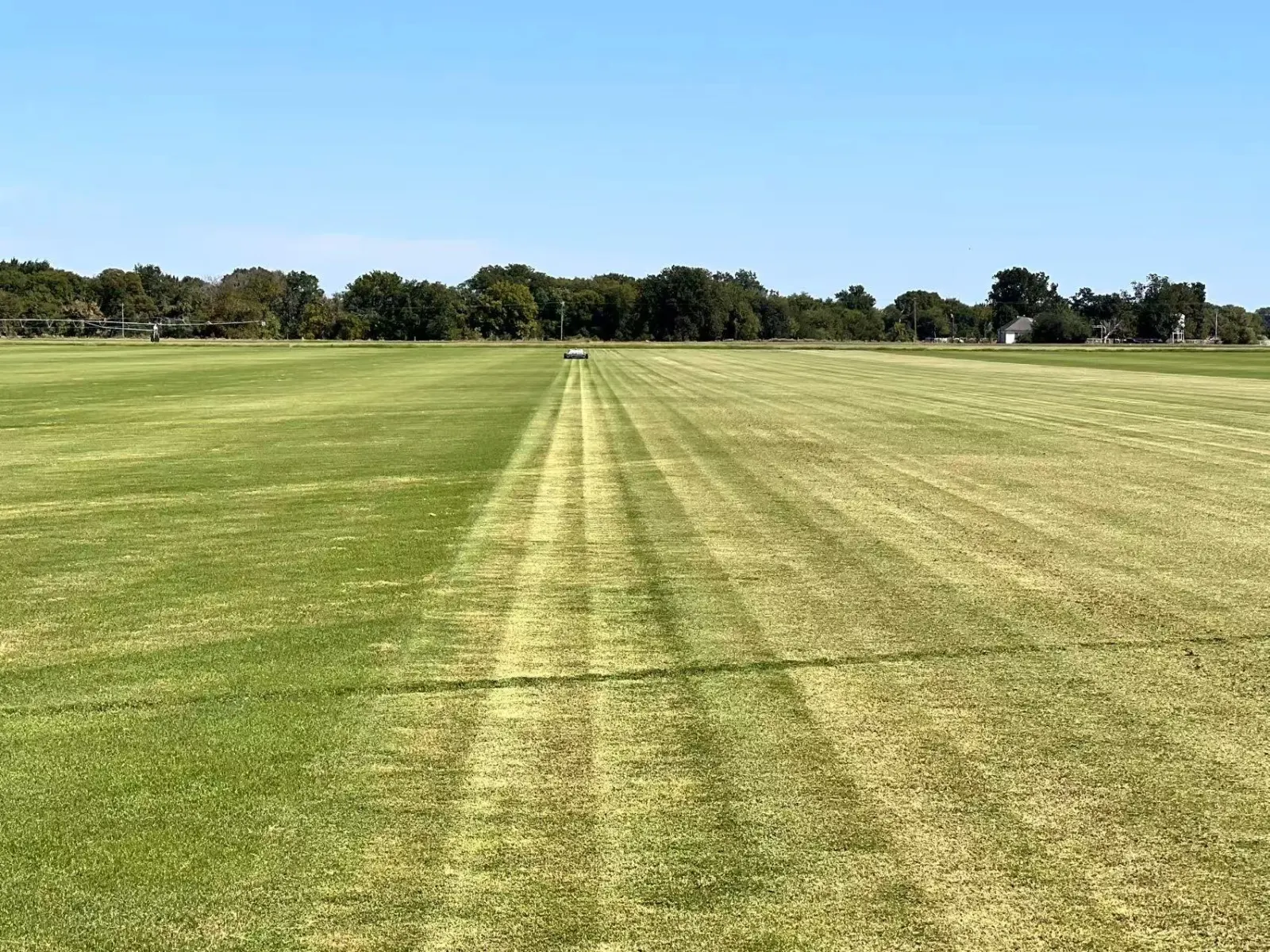
Pattern. A course is looked at from every angle by people who notice. Random-pattern robot mowers produce an even cut but no line. RTK-guided routing produces the same stripe pattern every cycle, in the direction you set it.
Boundaries without wire. Bunkers, beds, drainage, cart paths and marked areas are defined in software. Nothing is trenched in, and nothing gets cut by an aerator or a drainage crew two seasons later. Boundaries can also be changed in an afternoon when the layout changes — try that with buried wire.
Terrain: the reason four-wheel drive is on the spec sheet
Golf ground is not flat. Bunker surrounds, mounding, ditch lines and bank faces are exactly where two-wheel-drive machines lose traction, spin, and leave a patch that somebody then walks out to with a trimmer — which is the labour you were trying to avoid in the first place.
All four wheels of the A60i are driven, on turf tires, with an automotive-grade all-aluminium body that makes the machine 30 to 50 percent lighter than comparable machines — which on a course matters twice over: it climbs what heavier machines slip on, and it does not print wheel tracks into ground that gets cut every week. Slope capability on any given piece of ground depends on turf type, moisture and cut height, so we quote it against your conditions rather than printing a number that flatters us. More on terrain →
What the industry is actually doing
Autonomous mowing on golf courses is past the pilot stage. The USGA's Green Section has been covering the transition for several years, and courses in the US and Europe have moved from single-machine trials to fleets on ranges and roughs. The pattern in nearly every published account is the same: the machines take the repetitive acreage, and the crew hours move to detail.
Practical questions before you buy
Can it cut around a course while play is on?
It can, with defined exclusion zones and obstacle detection, but most courses get more value from running it outside play hours. That is the whole point of a machine that does not need an operator at 5am.
How much rough can one machine cover?
Roughly 15 to 21 acres on a single tank, up to twelve hours of mowing per fill - the range extender recharges the pack while it cuts, so there is no charging stop inside that shift. Actual daily output depends on how broken up the ground is and how heavy the growth is. Send us the layout and acreage and we will give you a figure you can plan against.
What about carts, players and staff crossing the area?
Obstacle detection and emergency stop are on board, and work areas are defined so the machine stays where you put it. Standard practice is to schedule it into windows when the area is clear.
Do we need our own RTK base station?
You need a correction source. Depending on your region that is either a network subscription or a local base station on the property. It is straightforward, but it needs to be sorted before delivery rather than after.
Can we see one on a course before committing?
Yes. Ask for a demo and tell us your location — we arrange on-site demonstrations and can connect you with operators running the machine on comparable ground.