Autonomous mowing for solar farms and utility sites
Vegetation management is one of the largest recurring O&M line items on a solar site, and one of the least pleasant jobs to staff. It is also close to an ideal application for an autonomous mower.
Why solar sites suit autonomous mowing better than almost anything else
Four site characteristics line up, and they rarely all line up together:
- Large, repetitive acreage. Row after row of the same geometry, cut multiple times across the growing season.
- Fixed, surveyed obstacles. Arrays, inverters, pedestals, trackers and cable runs do not move. They can be defined once as no-go zones and then trusted.
- Nobody is watching the stripe pattern. Cut quality has to control growth and keep shading and fire load down. It does not have to look like a fairway.
- Nobody wants the job. Walking a string trimmer through rows in July is the work that is hardest to hire for and highest in turnover.
Put those together and the machine spends most of its day cutting long, predictable lines through ground that a person would rather not be in.
The specific problem: growth under and between rows
Vegetation on a solar site is not cosmetic. Left alone it produces three real costs:
Shading losses. Growth against the lower edge of a module reduces output, and it does it silently — the site keeps producing, just less than it should.
Fire load. Dry vegetation under an array is a hazard, and in many jurisdictions keeping it down is a compliance obligation rather than an option.
Access. Overgrowth slows every other maintenance task on the site, from string testing to tracker service.
All three get worse on the same curve: cheap to prevent, expensive to catch up on. Which is exactly the profile of a job that suits a machine that can go out every week without anybody being scheduled.
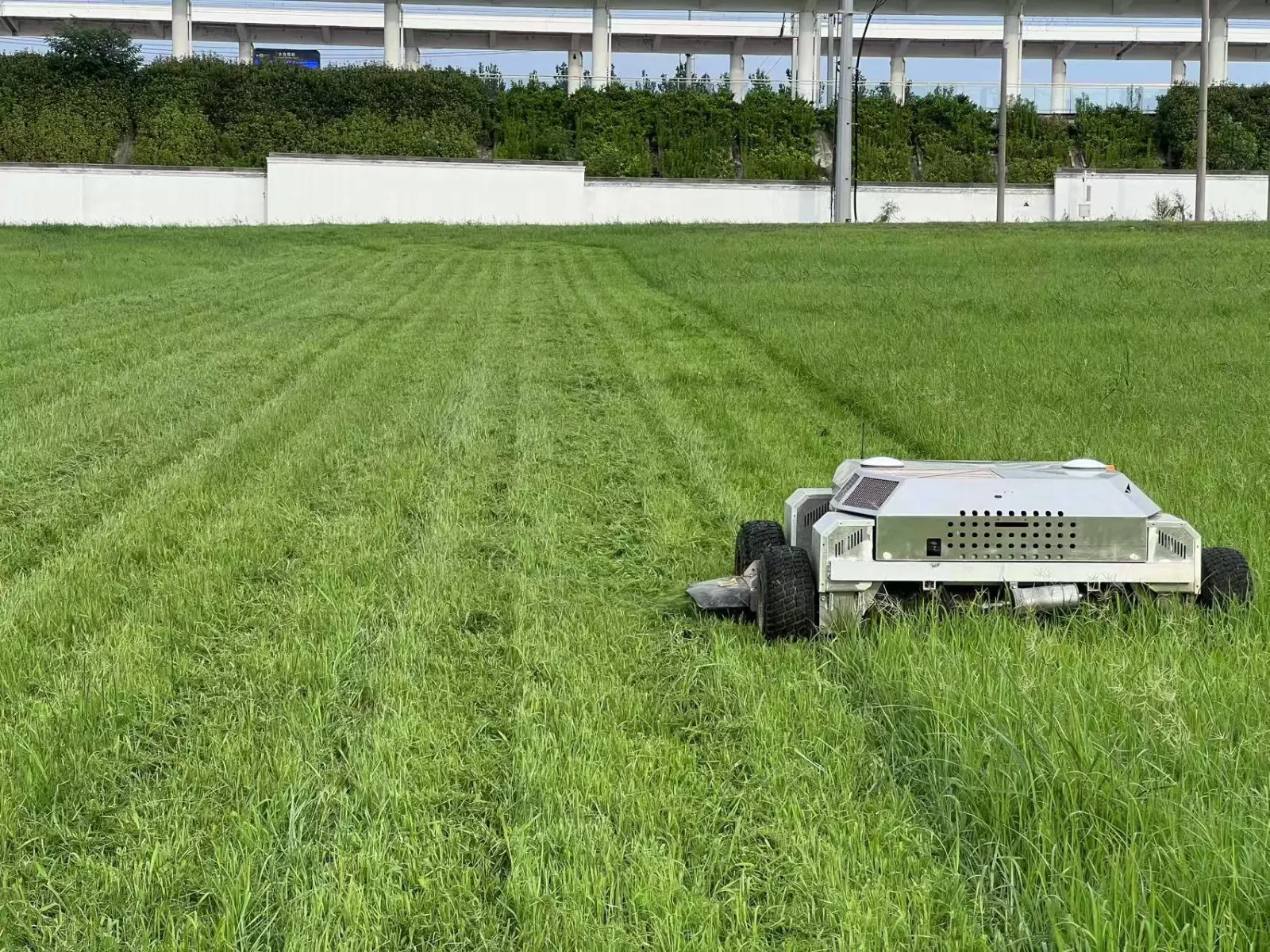
What the A60i brings to this specific job
RTK guidance and permanent no-go zones
Work areas and exclusions are defined in software to about one inch of position accuracy. Array footprints, inverter pads, pedestals and cable runs are drawn once. There is no boundary wire to install across a site of that size — which on a solar farm would be an installation project in its own right — and no wire for a service crew to sever later.
Four-wheel drive on unmaintained ground
Solar sites are not turf. They are compacted access lanes, soft ground after rain, ruts, and slopes on graded pads. Driving all four wheels keeps the machine moving where a two-wheel-drive unit would spin and stall, and the automotive-grade all-aluminium body — 30 to 50 percent lighter than comparable machines — keeps it on top of soft ground instead of sinking into it. More on terrain →
Hybrid runtime, on a site with no convenient outlet
This is the part that matters most here. A battery-only machine needs a charging station, which needs a power run, on a site where the electrical infrastructure is emphatically not designed for you to plug into. The A60i's constraint is a fuel tank — twelve hours of mowing per fill — and a fuel can travels to the machine. Why duty cycle decides output →
Cut height set remotely
Height under a fixed-tilt array and height on an open access lane are not the same setting. Changing it remotely rather than pulling pins at the deck means the site actually gets cut at the right height instead of one compromise height everywhere.
Honest limits on a solar site
- Under-module clearance. A 60-inch machine cuts between and around rows, not into low clearances under fixed-tilt panels. Some sites will still need handheld work at the module edge, and a machine that pretends otherwise will damage something.
- Very rough or rock-strewn ground. Rotary decks and rocks do not mix. Sites that have never been graded may need a first cut by other means.
- Sheep. On some sites, grazing is genuinely the cheaper answer. If it works for you, it works.
- Site security and access. An unattended machine on a fenced, monitored site is straightforward. On an open site it is a conversation about supervision.
Questions we get from O&M teams
How many acres can one machine keep on cycle?
Roughly 15 to 21 acres per tank with continuous operation, so the practical question is how many cutting cycles per season your site needs and what your growth rate is. Send us site acreage, row layout and how many cuts a season you currently do, and we will work it out rather than guess.
Can it work around trackers?
Tracker rows change geometry through the day, so the exclusion strategy is different from fixed-tilt. Tell us which system you have and we will be specific about what the machine can and cannot do around it.
What happens if it loses RTK correction mid-job?
The machine stops rather than guessing. On a site full of expensive fixed assets that is the only acceptable behaviour, and it is why correction source planning is part of commissioning.
Is there a fire risk from a combustion range extender on a solar site?
It is a fair question and the answer is site-specific: fuel handling, hot surfaces and dry vegetation all have to be managed the same way they are for any other mowing equipment currently on your site, which for most operators today is gas-powered. If your site has a no-combustion policy, say so up front — that is a case where a battery machine is the right answer.
Can we trial it on one block before committing to the site?
Yes, and it is the sensible way to buy. Get in touch with your location and site details.