Robotic mowers for airports and sod farms: the same problem, two industries
An airfield and a production turf field have nothing in common on paper — one is aviation infrastructure, the other is agriculture. To an autonomous mower they present the identical problem, which is why these are the two applications where a wide robotic deck pays for itself fastest.
Ask a golf superintendent, a grounds manager and a sod grower what their mowing problem looks like and you get three different answers. Ask an airport landside team and a turf farm foreman the same question and you get almost the same answer twice: too much open ground, too few people, and a job that does not get smaller because the season is slow. That overlap is not a coincidence — it comes from the shape of the ground itself, and it is why airport mowing and sod farm mowing are the two use cases where a 60-inch autonomous mower is doing the least turning and the most cutting.
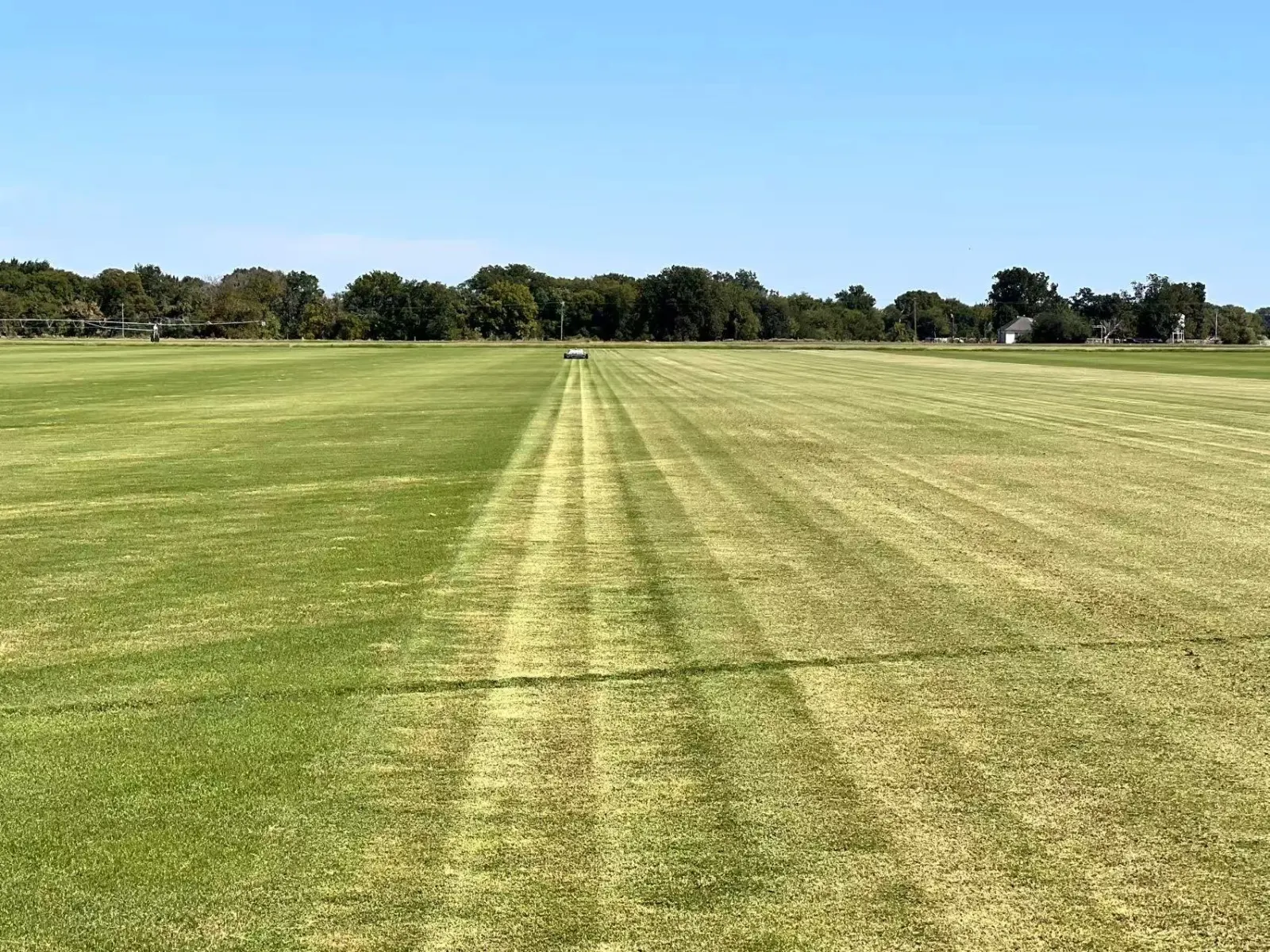
What an airfield and a turf farm actually have in common
- Enormous open runs. Airfield infields, verges and perimeter fence lines run in long straight lines with no beds, no trees and no street furniture. Sod fields are laid out for machinery in the first place, with pass lengths measured in hundreds of yards. Both are the condition a wide deck is built for — cutting instead of turning.
- The acreage never shrinks. An airport's grounds team is managing hundreds of acres whose grass height is a safety and wildlife-attraction question, not a cosmetic one. A sod grower is managing production turf that is cut on a fixed cycle through the whole season because the crop is the grass. Neither job goes on hold when staff are short.
- Labour that is hard to keep. Driving a mower in straight lines for ten hours is the job with the highest turnover on most crews, aviation or agricultural. It is also the easiest job to hand to a machine, because there is nothing improvisational about it.
- No convenient place to charge. Airside power runs are a construction project. Power at the far end of a production field is a trenching project. Both sites need a machine that works a full shift without an outlet nearby, which rules out charge-and-wait battery machines before it rules out anything else.
Why weight decides what the machine is allowed to touch
Airfield infields are drained but not manicured, and they go soft after rain. Sod fields are the product — wheel-track compaction shows up as lanes that grow, colour and lift differently, and it is visible in the finished roll. In both places, the mower's own weight is not a comfort spec, it is an admission ticket.
The A60i's automotive-grade all-aluminium body makes it 30 to 50 percent lighter than comparable 60-inch autonomous machines. On turf tires that keeps ground pressure low enough to work soft infield ground without rutting it, and light enough on a sod field that the root zone the crop depends on is left intact. The same specification answers a safety question on one site and a saleability question on the other.
Twelve hours on one tank, because neither site has an outlet where the work is
The A60i is a hybrid: an onboard range extender recharges the battery pack while the machine mows, so one 36-litre tank is 9 to 12 hours of continuous work, roughly 15 to 21 acres, with refuelling being a fuel can wherever the machine happens to be. Nothing gets built, nothing gets trenched, and no cabling gets added to ground that has to stay clear — airside or in the middle of a production block. Why duty cycle decides daily output →
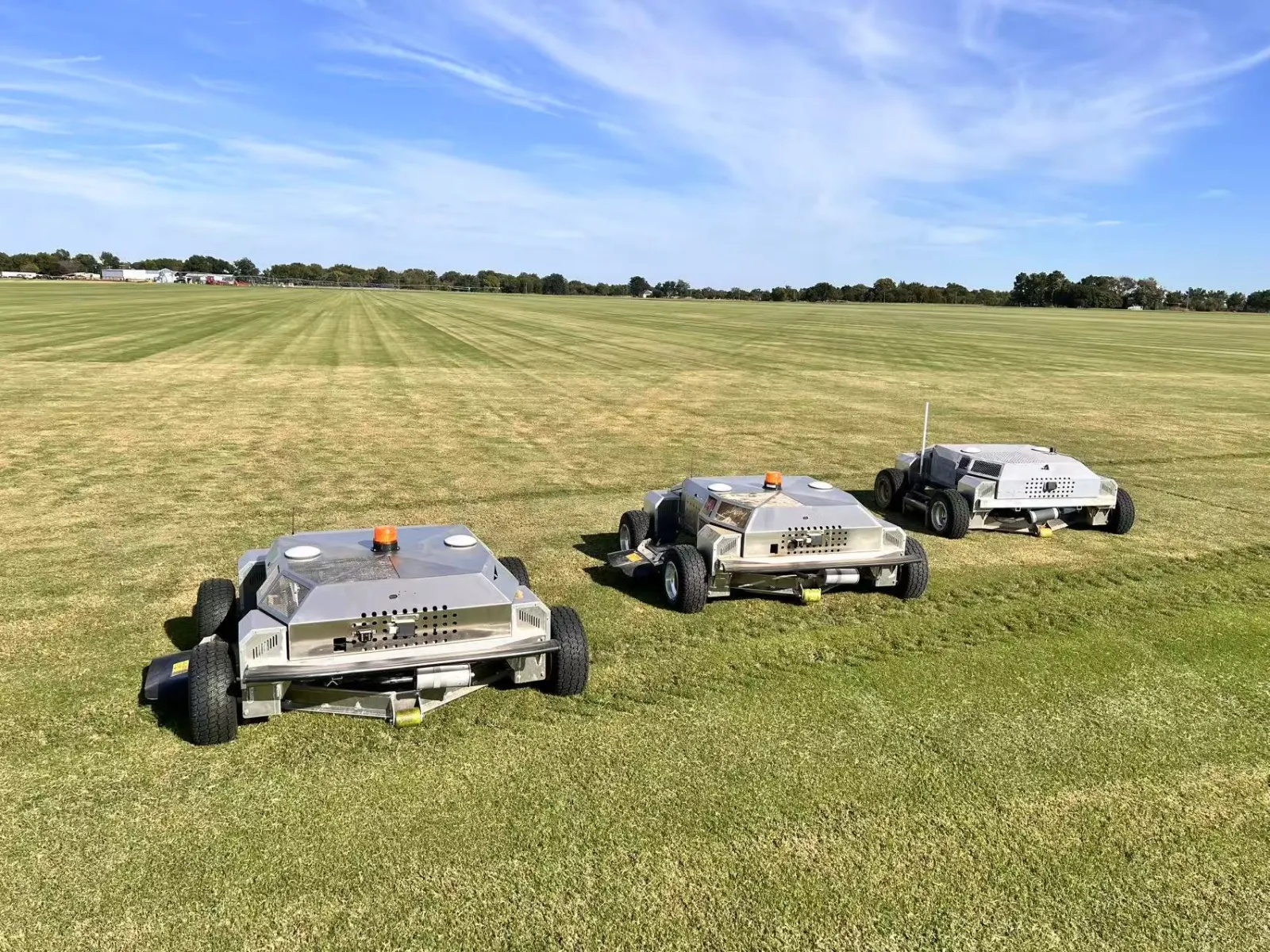
RTK guidance does two different jobs on the same specification
Both sites lean on the same one-inch RTK accuracy for opposite reasons. On an airfield, exclusion zones around lighting, signage, antennas and drainage structures are defined in software and held to; the machine stops rather than continuing on a degraded correction, which is the only acceptable behaviour near a movement area. On a sod field, that same accuracy is what lets lanes butt edge to edge without an overlap band being cut twice or a missed strip running through a block that is about to be harvested — and it makes the cut pattern repeatable between visits regardless of who set it up.
Where each application actually starts
Neither of these is a one-machine-does-everything pitch, and the honest starting point is different on each site:
- Airports generally begin landside — terminal frontage, car park verges, access roads — and extend to perimeter, fence lines and eventually infields once an operator's own safety case is written. Full detail on airfield mowing →
- Sod and turf farms generally start with the largest, most uniform production block, because that is where acre-cuts per machine are highest, then scale to a fleet once the first machine has a season behind it. Full detail on turf farm mowing →
Send us the layout. Acreage, field or infield dimensions, cutting frequency and whether you have an RTK correction source already — and we will give you a realistic machine count and a planning figure rather than a single quote and a guess. Talk to us →
Common questions
Is the same machine really used for both an airfield and a sod farm?
Yes — the A60i is not configured differently between the two. The specification that matters on both is the same: light aluminium body, RTK guidance to about one inch, and a hybrid powertrain that runs a full shift without a charging stop.
How much ground can one robotic mower cover on an airfield or turf farm?
Roughly 15 to 21 acres on one tank, up to twelve hours of work per fill, on the long uninterrupted runs both site types provide. Send us acreage and layout and we will give you a planning figure and a realistic machine count.
Do these sites need their own RTK correction source?
Most already have one for other guided equipment. If not, a local base station is straightforward to add but has to be set up before delivery — this is part of commissioning on both an airfield and a production field.
Can multiple machines work the same site?
Yes, and it is one of the few conditions where adding a second or third machine makes immediate sense — the acreage is large, the work is uniform, and each additional machine adds acre-cuts without adding staff. Fleet layout is part of commissioning.