Property managers, golf courses, municipalities and contractors with real acreage are steadily moving from operator-driven gas mowers to autonomous machines. But "robotic mower" covers everything from an $800 garden robot to a $40,000 commercial machine, and the differences matter more than the category name does. Here is where a four-wheel-drive autonomous mower like the Amotrol A60i genuinely changes the job.
1. It keeps traction where two-wheel-drive machines stop
Most robotic mowers drive one axle. On a bank, weight transfers off the uphill wheels, the driven wheel loses grip, and the machine either stops climbing or spins and tears the turf. Neither outcome is autonomous: somebody has to walk out with a trimmer and finish the patch it left.
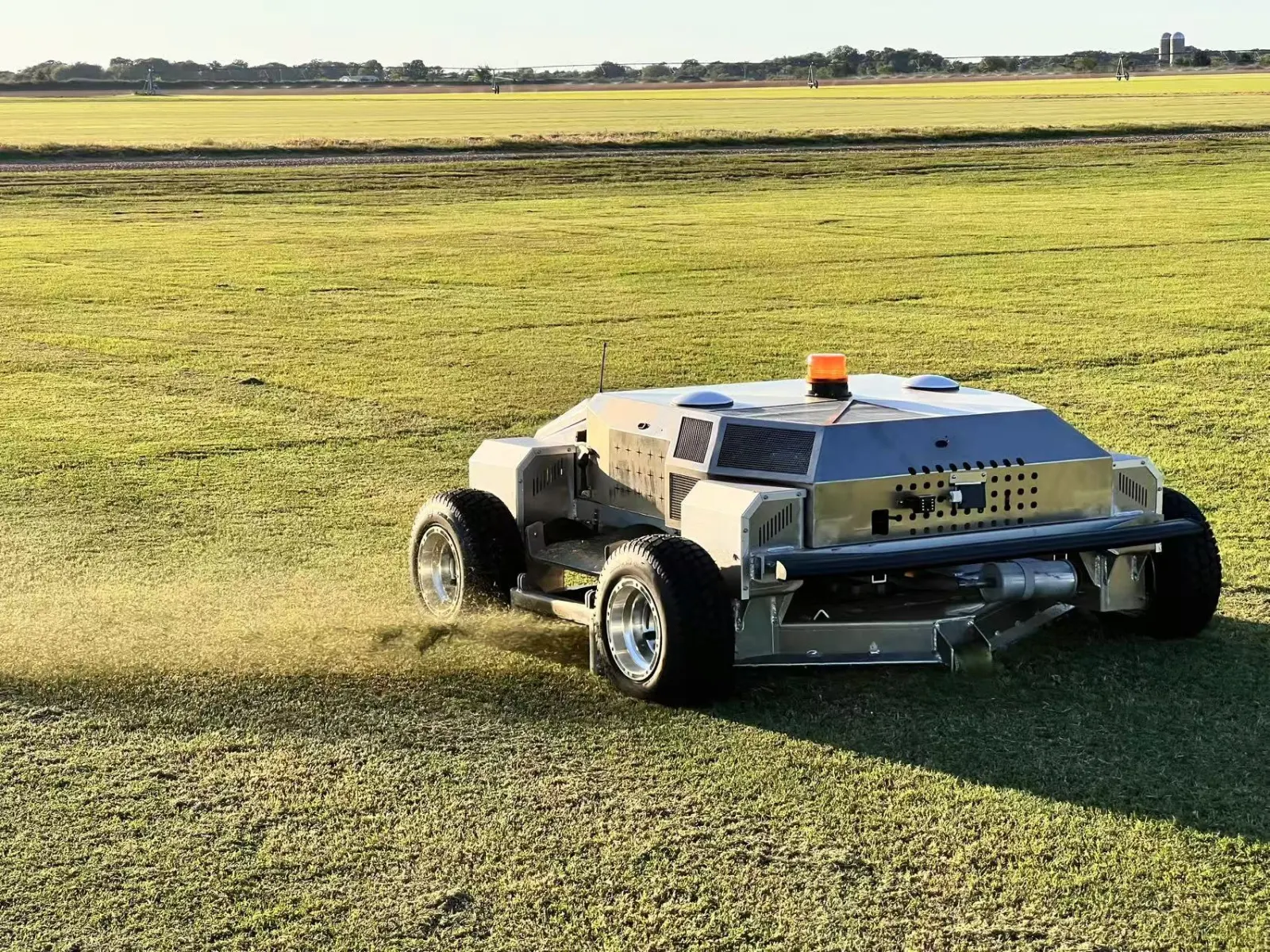
The A60i drives all four wheels, on turf tires, with an automotive-grade all-aluminium body that makes it 30 to 50 percent lighter than comparable machines — less mass to hold on a grade, and less mass printing wheel tracks into ground you cut every week. Traction degrades gradually with grade and moisture instead of disappearing at a threshold. On rolling ground, ditch lines, basin walls and rutted margins, that is the difference between a machine that finishes the area and one that finishes most of it.
One caution while you are comparing spec sheets: slope ratings in this industry are quoted sometimes in degrees and sometimes in percent, and the two differ by more than a factor of two. Ask every supplier to confirm which unit they mean, in writing. We quote slope capability against your actual ground rather than a single headline number, and we explain why here.
2. It covers ground without an operator standing on it
A conventional mower consumes an operator-hour for every hour of cutting. That is the entire cost structure of traditional mowing, and it is why the mowing budget scales linearly with acreage.
The A60i covers roughly 15 to 21 acres on one tank under RTK GPS guidance accurate to about one inch, following a planned route rather than wandering inside a boundary. Passes butt edge to edge, so there is no overlap band being cut twice and no missed strip needing a return visit. Meanwhile the crew is doing the work that actually requires people: edging, detail, irrigation, agronomy.
The point is not that the machine mows. It is that the mowing stops competing for the same hours as everything else.
3. Fuel and running cost drop, and they drop for a structural reason
The A60i is a hybrid, and one tank of gasoline is twelve hours of mowing. A small engine drives a generator that charges the battery pack; electric motors drive the wheels. Because the engine holds one efficient operating point instead of following the load through turns, climbs and heavy patches, fuel consumption comes in up to 30% below a conventional commercial mower on comparable work.
Set against labour, the gap is larger still. Contracted commercial mowing is commonly quoted around $40 per acre; autonomous mowing is commonly modelled at roughly $10 per acre in direct running cost. Across a season of weekly cuts, that gap is what pays for the machine — run it against your own acreage, and note that the calculator will tell you plainly when the numbers do not work.
The hybrid arrangement also avoids the charging window that limits battery-only machines. That is a longer argument, and it has its own page.
4. Cutting is precise, repeatable, and adjustable without touching the deck
Cutting height is set remotely rather than by pulling pins at the deck, so moving between a maintained field and a rough margin is a setting rather than a job. Obstacle detection and an emergency stop are on board, and no-go zones around beds, bunkers, pedestals and trees are defined in software.
Because routing is planned rather than random, the stripe pattern comes out the same every cycle, in the direction you set. On any surface people look at — a range, a field, a frontage — that consistency is visible, and it is not something a random-pattern robot can produce.
5. It is quiet enough to work when the property is empty
Gas commercial mowers sit above 90 dB, which is why mowing tends to happen in daylight and why it generates complaints. A machine quiet enough to run at first light or after closing finishes the ground before anyone arrives.
On a golf course that means the rough is done before the first group. On a school campus it means fields are cut before students are on them. On a municipal site it means the park is finished before it fills up. None of that shows up in a cost-per-acre figure, and for many buyers it is the deciding factor.
Where a traditional mower still wins
Worth saying plainly, because it is often the right answer:
- Small, obstacle-dense properties. Beds and trees every thirty feet mean the machine spends its time turning. A crew with zero-turn mowers stays faster.
- Fine turf needing a reel cut. Greens and tees are not rotary work, autonomous or otherwise.
- Infrequent cutting. If the ground is cut a handful of times a year, the acre-cut count never reaches the level where capital cost is recovered.
- Ground with buried rock or heavy debris. Rotary decks and stone do not mix on any machine.
If your property is mostly open acreage that gets cut every week through a long season, and you are short of people rather than short of budget, autonomous mowing is worth costing out properly. If it is not, we would rather tell you that now. Send us the site details and you will get a straight answer.